


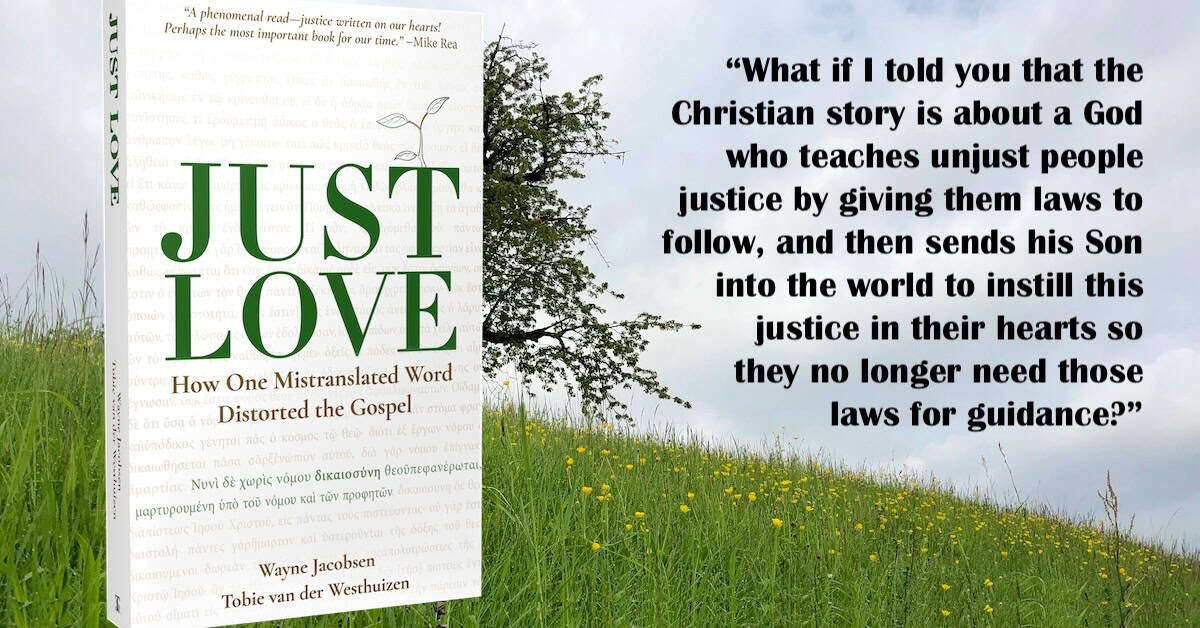
Just Love – Chapter 1
All my life, I have sought an authentic Gospel that does everything Jesus promised. It would rescue those perishing in the darkness of this age and invite even the simplest people into an intimate engagement with his Father that would lead them to life—here in this age and the age to come. Connecting with him would unravel the darkness that twists our world into pain and bondage and lead his people into the ever-increasing joy of knowing him and the freedom of being transformed by his love.
Seventeen months ago, I got an email from a stranger in South Africa that told me there was a significant flaw in our English translations of the Bible. Tobie van der Westhuizen had discovered that the Greek word translated as ‘righteousness’ for the past 500 years is actually the word for justice. Early translators had chosen a word in English that had no equivalent in Greek or Hebrew, and using it had led to a distortion of the Gospel Jesus would have preached, and Paul would have explained. Admittedly, I was skeptical at first, but the more I explored his research, I realized that he was on to something. That led to hours of conversations and eventually an idea for this book called Just Love: How One Mistranslated Word Distorted the Gospel.
We are excited to release this book on Tuesday for others to explore this with us. It may seem like a subtle shift at first, but he implications are profound. I haven’t been as excited about a book I’ve helped to write since The Shack. And honestly, this completes the message of He Loves Me, which I’ve often said is the most significant book I’ll ever write—until now! This is how God’s love not only flows to us, but through us to change the world we inhabit. I can’t tell you how excited I am to finally see this book in print.
In advance of that release, here is Chapter 1 of what I hope will help us see the power of a Living Gospel, which was not just meant to save us from hell, but also to transform us by the power of Christ to change the way we live and love in this age.
_____________________________
 Chapter 1
A MISSING PIECE
Buckle up—we are about to take you on a journey that has profoundly shifted our understanding of Scripture and, even more importantly, the trajectory of our spiritual lives. It just might for you, too.
What if you discovered that a mistranslated word in Scripture distorted its meaning for us today? And what if that one word was so significant that getting it right might alter not only the course of your life, but of Christianity itself?
We want to suggest to you that while the Reformation was a crucial step forward in freeing followers of Jesus from performance-based religion, the way it’s often misunderstood today may unintentionally obscure the best part of salvation—Jesus’s desire to transform us from within so we reflect his kingdom in this present age.
We reached these conclusions by very different routes. I (Wayne) arrived here relationally. More than thirty years ago, I encountered the Father’s love in a way that rewrote my spiritual story, especially after growing up in more legalistic environments. Tobie’s path was fueled by a hunger for authentic faith, guided by linguistic and theological insights that I had never considered.
When our lives intersected in late 2024, everything clicked. What Tobie shared explained how love had already been teaching me to live. Now I had Scriptural terminology for it. By resolving a mistranslation of a single English word in Scripture, I could finally see the map of the spiritual territory I’d wandered through for decades. The rich conversations that followed launched this collaboration—and ultimately this book.
If what we propose is true, it unifies Scripture from Genesis to Revelation, weaves salvation and the kingdom of God together, and clarifies what Jesus intended for our transformation. It doesn’t replace the Gospel I learned earlier—it completes it. Others throughout history have tried to call God’s people back to this simple, transformative reality, but the noise of cultural religion has often drowned out their voices.
So, we write in hopes that you’ll consider these things. Search the Scriptures to see if they hold up. If they do, you too can step into a fuller, more vibrant experience of the Gospel today.
When Something Doesn’t Add Up
Have you ever been in a situation where nothing seemed to make sense, only to learn later that it was because you didn’t have all the information?
I recently went through something similar in my marriage. Unbeknownst to either of us, my wife, Sara, had been sexually assaulted by family members between the ages of four and eight. Un- able to process her pain at such a young age—and having no one safe to confide in—her mind buried those memories deep within her. But in her fifties and sixties, a deep pain began to push its way to the surface. Erupting like a volcano, it manifested as complex PTSD and a deep self-loathing that pushed her toward suicidal thoughts. Unable to contain or explain her anguish to anyone, she hid it behind kindness and caretaking, fawning over everyone—including me—so no one would discover what a horrible person she thought herself to be.
During that time, our conversations made little sense to me. I sometimes thought she was being evasive, but my attempts to understand her only led to frustration for both of us. Caught in the torment of a trauma she did not remember, Sara said whatever she thought I needed to hear just to survive the moment. Eventually, the debilitating pain drove her to seek counseling, and she was told she must have been traumatized. Because she had no memories of her childhood abuse, the counselor wrongly concluded that she must be married to an abusive husband. She encouraged Sara to leave me, which she did while I was away on a twelve-day trip to the East Coast.
Imagine my shock when I got home to a letter sitting on the kitchen counter, saying that our marriage had been painful for her, and that she either had to take her life or leave me. Thankfully, she chose the latter, but the shock of her leaving devastated me. This wasn’t the woman I had been married to for forty-seven years. As far as I knew, our life had been wonderful, with minimal conflict. What was I missing?
It took five weeks and a change in counselors for us to find our way back to each other. That’s when Sara discovered that I had not been the source of her pain. The real “monster” came from a deep-seated trauma inflicted by her extended family decades earlier. I’ve since walked beside her as those memories have surfaced and as Jesus heals her heart and rewires her mind.
Discovering her childhood trauma was the missing piece we both needed. Once that came to light, we understood not only the pain she endured and why she coped with life the way she did, but also how even my most innocent actions could trigger her trauma. That insight is what we needed to walk into the future with increasing healing. Today, I get to stand by Sara as her husband, encourager, and confidant as she continues her courageous journey toward wholeness.
Over the past year, I’ve had a similar revelation in my theological journey. I have come across a missing piece in my understanding of salvation and the kingdom of God. Like discovering Sara’s trauma, this new insight illuminated not only my past and the struggles I’ve had with some aspects of Christianity, but it also gave me a renewed vision for what salvation was truly meant to be.
For years, I’ve wrestled with a troubling question: How could Christianity produce so many converts and so few deeply transformed lives? Too often, salvation is seen merely as a ticket to heaven, rather than the beginning of a new kind of life here. As a young pastor, I was discouraged by how many believers seemed to seek only the minimal commitment necessary to “stay saved.”
For two thousand years, we have been more preoccupied with fighting sin—and often each other—than learning to love our neighbors. Yet, Jesus said that the world would recognize us by our love. (John 13:34–35) Sadly, that’s not the testimony most people see. Dallas Willard described our approach to discipleship as the “Gospel of Sin Management”—a message that drives people to try harder, only to feel more shame when they fail. But that’s not the Gospel Jesus brought. It’s simply another form of the old performance-based religion he came to free us from.
What I’ve come to realize is this: There’s a vast difference between practicing a religion called Christianity and actually living in the life of Jesus. Somewhere along the way, I had missed a crucial piece of the Gospel.
_____________________________
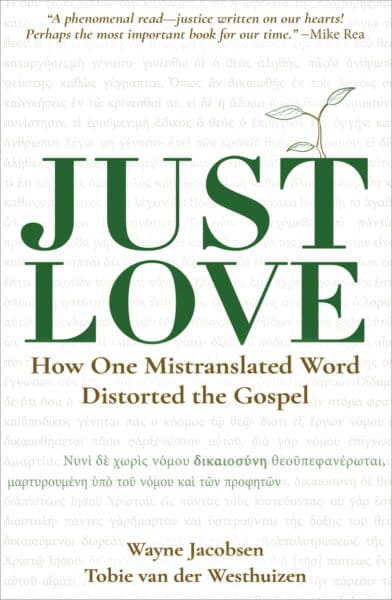 Just Love:
How One Mistranslated Word Distorted the Gospel
by Wayne Jacobsen and *Tobie van der Westhuizen
174 pages
Trailview Media
Available from Amazon, Tuesday, March 3
in Kindle ($10.99)
or in Paperback ($16.99)
 *Tobie is a former pastor and holds a PhD in Higher Education. In addition to his work overseeing a private school in Bloemfontein, SA, he writes at JusticeofGod.com and answers questions on the Bible and spiritual matters at quora.com/profile/Tobie-28.
Hear Wayne, Tobie, and Kyle discuss their new book on the most recent edition of The God Journey.