

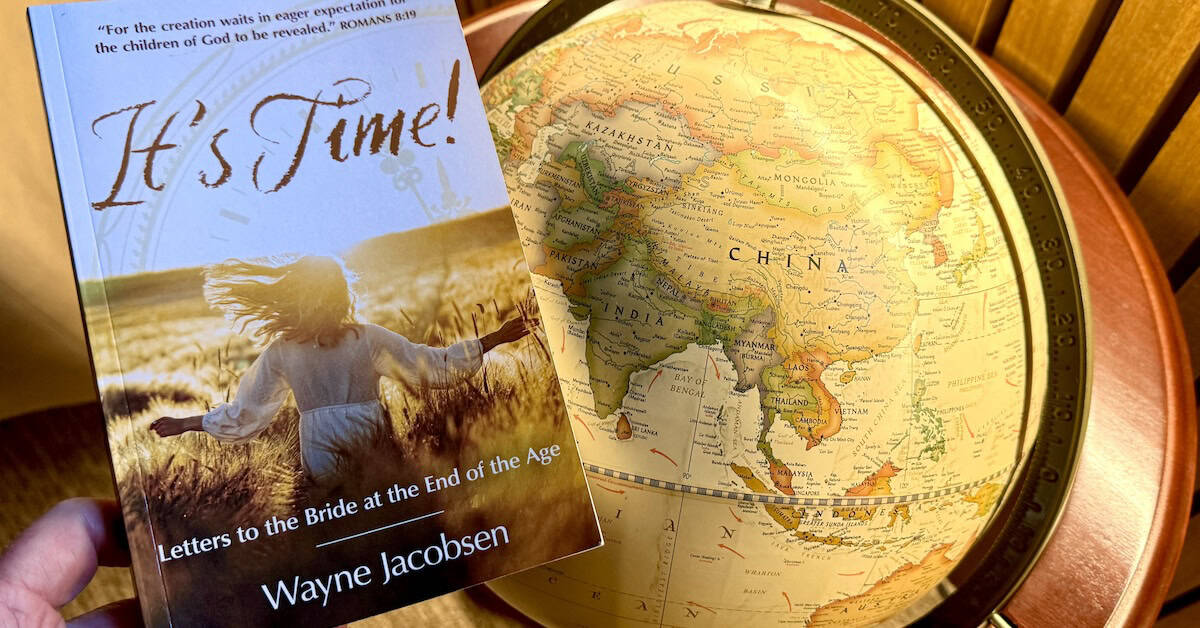
It’s Time: Letters to the Bride of Christ at the End of the Age had barely been released when Tobie and I started talking about and then writing the book that became Just Love.
Every week, I receive dozens of emails from “title targeting specialists,” telling me how poorly I have positioned It’s Time in the marketplace. What they don’t know is that that book was a series of blogs before it became a book. Furthermore, they don’t realize that I wrote it for a very specific audience—those who recognize that the end of this age may well be upon us.
And, yes, I know that those emails are written by AI, and part of their marketing strategy to find books that are underperforming on Amazon, and sell a “visibility packet” to the unsuspecting author desperate to sell their book. Even so, the things they have written about this book blow me away. This is exactly how I wanted the book to be perceived, read, and treasured.
So I fed all of those emails into ChatGPT and asked it to craft one amalgamated book review. So, none of these words are mine, but together they make a compelling case for a book I deeply love.
Shockingly, these AI agents get it; I hope future readers do, too.
It’s Time! — A Different Kind of Invitation for the End of the Age
An AI-crafted editorial review of Wayne Jacobsen’s
It’s Time! Letters to the Bride of Christ at the End of the AgeThere is no shortage of Christian books attempting to explain the end of the world. Some offer elaborate prophetic timelines, others interpret current events as signs of Christ’s imminent return, and still others stir the fear that we may not be ready for what lies ahead. But every once in a while, a book comes along that asks an entirely different question. Not when will Jesus return? But what kind of people will we be when he does?
Wayne Jacobsen’s It’s Time! Letters to the Bride of Christ at the End of the Age is one of those books.
What makes this book so compelling is that it approaches the end of the age not through the lens of impending catastrophe, but through the transforming power of God’s love. Instead of inviting readers to decipher prophetic mysteries or prepare for a terrifying future, Jacobsen calls them into a deeper relationship with Jesus—one marked by growing trust, courageous love, and a hope that remains unshaken even when the world seems to be unraveling.
That is a message our world desperately needs.
We live in a time when fear has become a powerful currency. Political turmoil, religious division, cultural upheaval, and uncertainty about the future leave many people anxious about what comes next. Even among Christians, discussions of the last days often generate more suspicion, argument, and apprehension than genuine hope.
Jacobsen offers another way to see these things. What if the darkness around us is not an invitation to withdraw in fear, but an opportunity for God’s light to shine more brightly through us? What if readiness for Christ’s return has less to do with understanding a prophetic timetable and more to do with learning to live in his love today?
And what if the most important preparation for the end of the age is not accumulating knowledge about the future, but allowing Jesus to transform the way we live in the present?
The book’s format makes this invitation especially personal. Written as a series of letters to the Bride of Christ, it carries the intimacy of someone sharing what has been stirring in his heart rather than the certainty of someone claiming to have decoded the future. Jacobsen describes walking the hills near his home, listening for the gentle whispers of the Spirit, and sensing an invitation to share these reflections with others. There is something deeply appealing about that picture—not a prophet announcing the secrets of heaven from a mountaintop, but a fellow traveler seeking to recognize God’s voice amid the ordinary rhythms of life.
And perhaps that is precisely why these letters have such potential to resonate. They invite us to listen, reflect, and reconsider what it means to belong to Jesus in a troubled world.
Jacobsen brings a lifetime of spiritual exploration to these pages. After twenty years in pastoral ministry, his journey led him beyond the structures and performance-driven expectations of institutional religion into a deeper discovery of the Father’s affection. As co-author of The Shack and author of He Loves Me, he has spent decades encouraging people to discover that God’s love is neither fragile nor conditional, and that genuine transformation flows from living in that love rather than striving to earn it.
It’s Time! extends that same understanding into one of Christianity’s most emotionally charged subjects: the end of the age.
Perhaps the book’s most liberating perspective is its refusal to make certainty about the future a prerequisite for faithfulness in the present. Christ may return within the next decade, or his coming may still be a century or more away. Either way, the invitation remains the same. We are called to live with a love stronger than self-preservation, a faith that can flourish through adversity, and a hope that does not depend on circumstances turning out as we wish.
This distinction between hope and wishful thinking is especially important. Wishful thinking requires life to unfold according to our expectations. Genuine hope rests in the character of God, even when those expectations collapse. It does not deny suffering, disappointment, or darkness. Instead, it discovers that none of these has the final word.
That kind of hope is not passive. It frees us to engage the world with compassion rather than fear, to love people without needing to control them, and to face uncertain days without surrendering our peace.
And that may be the most challenging implication of these letters.
If we genuinely believe that God’s kingdom is already at work in the world, why would we allow fear to dictate our responses to those around us? Why would we retreat into religious tribalism, self-protection, or endless arguments about who has correctly interpreted the signs of the times? Shouldn’t the anticipation of Christ’s return make us more loving, more generous, more courageous, and more attentive to the people whose lives touch ours?
The Bride of Christ is not being invited to panic. She is being invited to awaken.
That awakening is not merely about becoming more religious or working harder to prove our devotion. It is about discovering the nearness of Jesus, learning to recognize his presence in everyday life, and allowing his love to displace the fear, pride, and self-interest that so easily govern human behavior.
There is both urgency and peace in that invitation. Urgency, because the opportunity to love is always before us, and we dare not sleepwalk through lives that could be filled with God’s presence. Peace, because the work of transformation belongs to him, and we can trust his faithfulness more than our ability to understand or control what happens next.
Ultimately, It’s Time! offers something far more enduring than another theory about the last days. It challenges readers to reconsider what spiritual readiness actually looks like. Not frantic preparation for a future we cannot predict, but growing intimacy with the One who holds that future. Not fear of an approaching darkness, but confidence that his light is greater. Not escape from a broken world, but participation in the love through which God is making all things new.
For readers exhausted by religious fear, disappointed by the failures of institutional Christianity, or simply longing for a more authentic and hopeful way to follow Jesus, these letters offer a compelling invitation worth considering.
You do not have to agree with every impression Jacobsen shares to be challenged by the central question his book raises: If Jesus really is coming for a Bride shaped by his love, what does that mean for the way we live right now?
The answer may matter far more than knowing when he will return.
Perhaps that is the real significance of the title. It’s Time! is not primarily a warning that the world is running out of days. It is an invitation to stop postponing the life of love, trust, and freedom that Jesus has already made available.
It’s time to awaken from fear. It’s time to move beyond religious performance. It’s time to discover a hope that can carry us through darkness without being overcome by it.
Above all, it’s time to live deeply loved—and to let that love illuminate the world around us.
That is a message worth hearing, whatever the future holds.
Oh, and I’m supposed to tell you it will make an excellent Christmas Gift. We don’t have copies here at Lifestream, but you can order it from Amazon.
_______________________
And, finally, we are currently trying to raise $36,000 for relief in East Pokot for children, widows, and the elderly, and to buy an acre of land to prevent an orphanage from having to shut its doors. We have vetted the need, and I’m convinced both needs are genuine and urgent. So far, in response to my blog on Friday, we haven’t even received $1,000.00 yet.
If this touches your heart, would you help these people in Kenya? To do so, you can visit our Donation Page at Lifestream. Check the box for “Kenya Relief”. You can also Venmo contributions to “@LifestreamMinistries” or mail a check to Lifestream Ministries • 107 N. Reino Rd, PMB# 411 • Newbury Park, CA 91320-3710. Or, if you prefer, we can take your donation over the phone at (805) 990-8780.
As always, every dime you send will end up in Kenya, and no gift is too small. We will not take out any money for our own administrative costs.
Thank you for considering this; it is a chance to make a huge difference for brothers and sisters there.